
Many things shape us

As a young boy I was a voracious reader. My favorite authors during that time were poet Robert Frost and novelist Jack London. Robert Frost (1874–1963) and Jack London (1876–1916)were near-contemporaries, born only two years apart, who depicted American life at the turn of the 20th century. While both explored themes of nature and human endurance, Frost focused on rural New England pastoral life through poetry, while London emphasized raw naturalist adventure and survival in the Klondike. Later I would add John Steinbeck to my personal library and equally loved his works.
In my teenage years and further on other writers would inspire and challenge me. My college advisor introduced me to Aldo Leopold and Ed Abbey. They are foundational figures in American environmental literature who championed the preservation of wilderness, though with different approaches. Leopold’s A Sand County Almanac (1949) established a scientific, ethical "land ethic," while Abbey’s Desert Solitaire (1968) offered a more radical, confrontational, and passionate defense of the desert Southwest.
Then also came Wallace Stegner and Wendell Berry. Wallace Stegner (1909–1993) and Wendell Berry (b. 1934) were towering figures in American literature and environmental thought, connected personally through Stanford’s writing program, where Stegner mentored Berry. Both championed the importance of place, stewardship, and "sticking" (remaining rooted) in an era of exploitation, leaving lasting legacies in conservation literature. Stegner also mentored the radical Cactus Ed for a short time in that program as well.
Finally in my adult years as ranger/ecologist I spent a great deal of time with “the berries” as I like to call them; Wendell of course, Thomas, and Barry Lopez. Wendell Berry, Thomas Berry, and Barry Lopez are foundational, albeit distinct, voices in 20th and 21st-century environmental thought, literature, and ecological philosophy. While they are often grouped together as proponents of a new ecological consciousness, their contributions span agriculture, deep ecology, and travel literature.
Now in the middle of my 8th decade on the planet I have become an ecotheologian, an anonemoose monk who finds kindred spirits in a Franciscan friar and a wild storytelling mythologist. Richard Rohr and Martin Shaw are prominent contemporary spiritual thinkers who intersect in their focus on mysticism, nature, and the renewal of deep spiritual tradition over conventional dogmas. Shaw, a mythologist, has lauded and referenced Franciscan friar Rohr's work on the Universal Christ and contemplative prayer, exploring similar themes of wildness, myth, and spiritual embodiment. Lately I’ve been immersed in Liturgies Of The Wild by Shaw.
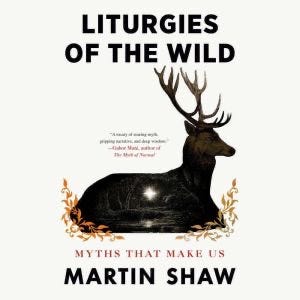
@Martin Shaw
I have recently stumbled into a conversation between Paul Swanson (he of the Center for Action and Contemplation) and Martin Shaw as they discuss Shaw’s Liturgies Of The Wild.
Swanson’s podcast Contemplify is the setting, though the places are Devonshire and New Mexico. It is a delightful “talk story” between two men I know a bit about. Ironically too, Robert Bly shows up in here…an important figure for Shaw, but a bit of an enigma to me? Swanson is well acquainted with Friar Richard Rohr who shares an affinity for the deeper things of life via mysticism and myth.
Herewith a link to that conversation should you be interested: https://contemplify.com/2026/02/01/dr-martin-shaw-on-liturgies-of-the-wild/